


-
-
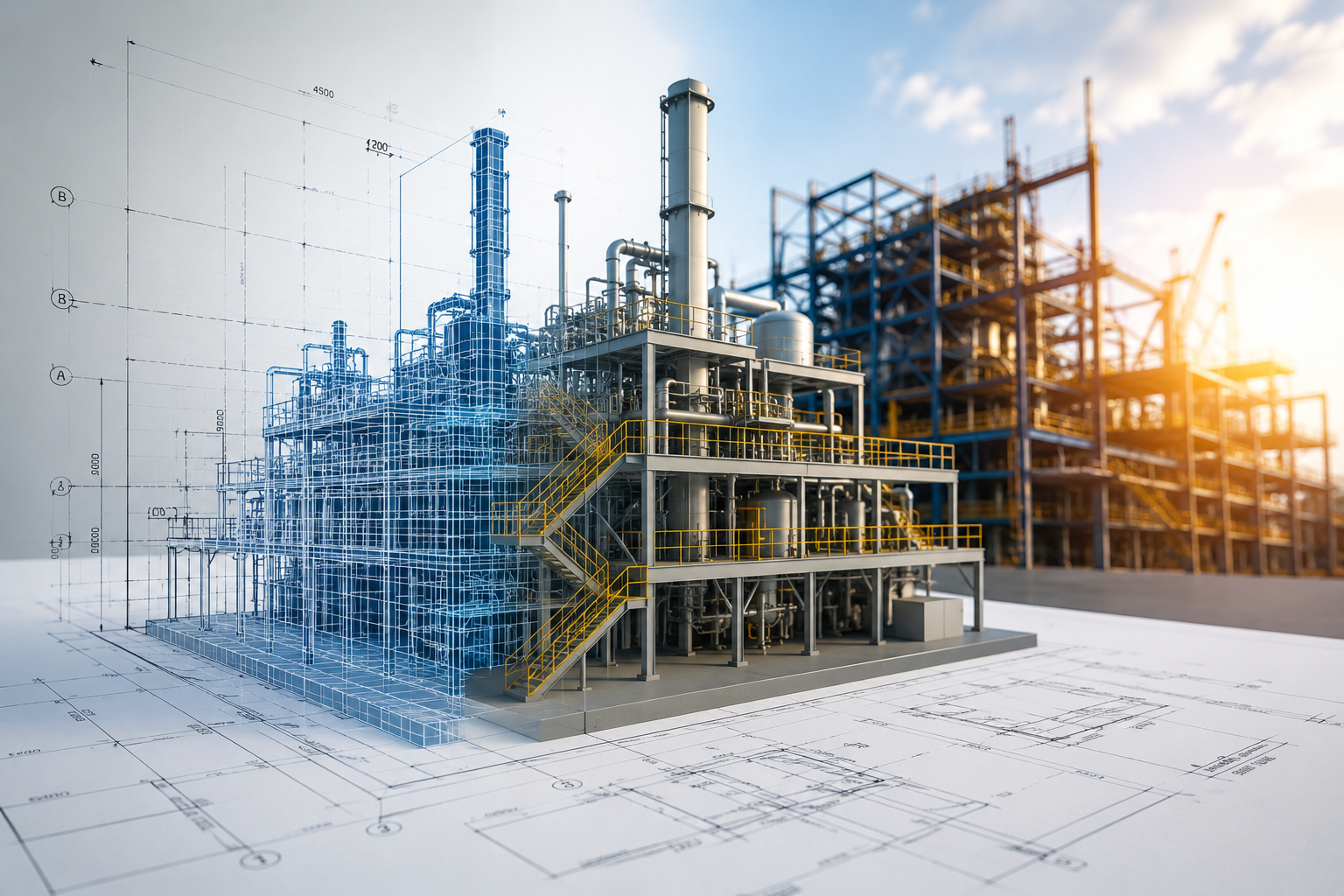
Modern industrial construction is becoming increasingly complex: the number of engineering systems, equipment units, technological processes, and coordination requirements continues to grow. In such conditions, even a minor design-stage error can lead to serious financial losses, construction delays, or costly rework.
That is why BIM design (Building Information Modeling) is becoming not just a trend, but a necessity for industrial facilities. STRON Engineering actively implements BIM technologies in the development of factories, production complexes, infrastructure, and engineering facilities in Kazakhstan.
What BIM is and why it matters
BIM is a digital information model of a building or industrial facility that integrates:
- architecture
- structural systems
- engineering networks
- equipment
- technological processes
- specifications and calculations
Unlike conventional drawings, BIM makes it possible to view the facility as a unified intelligent system even before construction begins.
Today, BIM is especially in demand for:
- factory design
- grain elevator construction
- metallurgical plant design
- development of production complexes
- integration of imported equipment
STRON Engineering — About the Company uses BIM and 3D modeling in the implementation of complex industrial facilities, including automotive plants, foundries, and grain processing complexes.
How errors increase construction costs
On industrial facilities, the cost of errors is especially high. The reasons include:
- a large number of engineering disciplines
- complex equipment logistics
- high density of engineering communications
- international technological production lines
- tight production launch deadlines
Typical errors without BIM:
Engineering system clashes
For example:
- ventilation systems intersect with cable routes
- pipelines interfere with steel structures
- equipment cannot be installed after construction is completed
Correcting such errors during construction costs many times more than resolving them at the digital modeling stage.
Equipment placement errors
In factories and production lines, every meter matters. Errors can lead to:
- reduced productivity
- inability to perform maintenance
- disruption of technological processes
Lack of coordination between disciplines
When architects, structural engineers, and engineering specialists work separately, the risk of discrepancies between project disciplines significantly increases.
How BIM reduces the cost of errors
1. Clash Detection Before Construction
The main advantage of BIM is the automatic detection of clashes between engineering systems.
This makes it possible to:
- eliminate errors before construction begins
- reduce the number of reworks
- minimize material losses
- save the client’s budget
In STRON Engineering — Industrial Design projects, BIM is used to coordinate engineering systems and technological equipment already at the design stage.
2. Accurate Equipment Integration
When designing modern production facilities, it is important to consider:
- equipment dimensions
- service and maintenance zones
- internal enterprise logistics
- installation constraints
BIM makes it possible to create digital twins of production facilities and verify in advance:
- accessibility for maintenance
- installation sequence
- compatibility of engineering systems
STRON Engineering — Conceptual Design uses BIM modeling to develop concepts for industrial facilities with consideration of technological processes and future operation.
3. Reduction of Construction Costs
BIM helps reduce:
- material overruns
- the number of reworks
- equipment downtime
- construction delays
Additionally, the digital model makes it possible to:
- calculate quantities more accurately
- generate specifications
- monitor project implementation timelines
According to studies in the field of BIM and digital design, the use of intelligent BIM models significantly improves the accuracy of engineering coordination and reduces the likelihood of design errors.
4. Improved Operational Quality
Errors made during the design stage affect not only construction but also the future operation of the facility.
BIM helps to:
- optimize equipment maintenance
- improve energy efficiency
- simplify production modernization
- accelerate facility management
This is especially important for:
- metallurgical enterprises
- agro-industrial complexes
- automotive plants
- food production facilities
Real BIM projects by STRON Engineering
STRON Engineering implements BIM design on projects of various scales:
- cast iron foundry in the Kostanay Region
- KIA Qazaqstan automotive production facility
- flour milling complexes
- grain elevators
- meat processing plants
- production and infrastructure facilities
The use of BIM allows the company to:
- coordinate international technological solutions
- adapt foreign projects to Kazakhstan standards
- reduce investment risks
- improve the accuracy of engineering solutions
Why BIM is becoming the standard of the future
Industrial construction is rapidly moving from traditional drawings to digital models.
Today, BIM is:
- risk control
- reduction of error-related costs
- faster design processes
- increased construction transparency
- efficient facility management
More about industrial design approaches and BIM technologies can be found in the STRON Engineering Blog and on the STRON Engineering — Industrial Design page.
Stron
Engineering
-
INDUSTRIAL ENGINEERING
-
01
Development of design and estimate documentation for the construction of civil and industrial facilities, in frame and frameless design, monolithic and prefabricated structures and buildings, metal structures, reinforced concrete;
-
02
Design of outdoor power supply systems, outdoor and indoor electric lighting, power electrical equipment and substations;
-
03
Design of trunk and intra-block fiber-optic communication lines, video surveillance systems, security and access systems;
-
04
Design of external water supply, sewerage, water drainage and drainage, gas supply, and heat supply networks;
-
05
Engineering surveys (engineering-topographic; engineering-geodetic; engineering-hydrological, engineering-geological;
-
06
Technical inspection of buildings and structures;
-
07
ВIM design;
-
08
3D laser scanning;
-
09
Qualified legal support for projects.
-
01
-
MINING & METALLURGICAL ACTIVITIES
-
01
Development of design and estimate documentation for the construction of mining facilities;
-
02
Adaptation of projects and technological processes in the mining and metallurgical sector of foreign projects and design solutions to Kazakhstani norms and requirements;
-
03
Design of roads and railways;
-
04
Development of environmental projects;
-
05
Industrial safety;
-
06
Preparation of tender documentation;
-
07
Evaluation and analysis of objects to determine the cost of engineering and design;
-
08
ВIM design;
-
09
Comprehensive implementation of author's supervision;
-
10
Development of projects for related infrastructure facilities for mining, processing and metallurgical industries;
-
11
Carrying out engineering survey work.
-
01
-
MINING & METALLURGICAL ACTIVITIES
-
01
Development of design and estimate documentation for the construction of civil and industrial facilities, in frame and frameless design, monolithic and prefabricated structures and buildings, metal structures, reinforced concrete;
-
02
Design of outdoor power supply systems, outdoor and indoor electric lighting, power electrical equipment and substations;
-
03
Design of trunk and intra-block fiber-optic communication lines, video surveillance systems, security and access systems;
-
04
Design of external water supply, sewerage, water drainage and drainage, gas supply, and heat supply networks;
-
05
Engineering surveys (engineering-topographic; engineering-geodetic; engineering-hydrological, engineering-geological;
-
06
Technical inspection of buildings and structures;
-
07
ВIM design;
-
08
3D laser scanning;
-
09
Qualified legal support for projects.
-
01
-
CIVIL AND INDUSTRIAL ENGINEERING
-
01
Development of design and estimate documentation for the construction of mining facilities;
-
02
Adaptation of projects and technological processes in the mining and metallurgical sector of foreign projects and design solutions to Kazakhstani norms and requirements;
-
03
Design of roads and railways;
-
04
Development of environmental projects;
-
05
Industrial safety;
-
06
Preparation of tender documentation;
-
07
Evaluation and analysis of objects to determine the cost of engineering and design;
-
08
ВIM design;
-
09
Comprehensive implementation of author's supervision;
-
10
Development of projects for related infrastructure facilities for mining, processing and metallurgical industries;
-
11
Carrying out engineering survey work.
-
01
-
CIVIL AND INDUSTRIAL ENGINEERING
-
01
Development of design and estimate documentation for the construction of civil and industrial facilities, in frame and frameless design, monolithic and prefabricated structures and buildings, metal structures, reinforced concrete;
-
02
Design of outdoor power supply systems, outdoor and indoor electric lighting, power electrical equipment and substations;
-
03
Design of trunk and intra-block fiber-optic communication lines, video surveillance systems, security and access systems;
-
04
Design of external water supply, sewerage, water drainage and drainage, gas supply, and heat supply networks;
-
05
Engineering surveys (engineering-topographic; engineering-geodetic; engineering-hydrological, engineering-geological;
-
06
Technical inspection of buildings and structures;
-
07
ВIM design;
-
08
3D laser scanning;
-
09
Qualified legal support for projects.
-
01
-
MINING & METALLURGICAL ACTIVITIES
-
01
Development of design and estimate documentation for the construction of mining facilities;
-
02
Adaptation of projects and technological processes in the mining and metallurgical sector of foreign projects and design solutions to Kazakhstani norms and requirements;
-
03
Design of roads and railways;
-
04
Development of environmental projects;
-
05
Industrial safety;
-
06
Preparation of tender documentation;
-
07
Evaluation and analysis of objects to determine the cost of engineering and design;
-
08
ВIM design;
-
09
Comprehensive implementation of author's supervision;
-
10
Development of projects for related infrastructure facilities for mining, processing and metallurgical industries;
-
11
Carrying out engineering survey work.
-
01
-
What We Offer:
Employment:
Work in a Kazakhstan-based company
Salary:
USD 3–5 per hour.
Payment is task-based: each task is assigned with a clearly defined number of hours based on an 8-hour workday. If a task is completed ahead of schedule, payment will be made upon actual completion.
Location:
Kostanay, Kazakhstan
Key Responsibilities:
Architectural design solutions;
Coordination with engineering disciplines.
Requirements:
Higher education in Architecture;
At least 10 years of experience on industrial projects;
Technical English proficiency (mandatory);
Proficiency in Archicad, AutoCAD, Revit;
Mandatory experience working with BIM;
Relevant professional certificates and completion of specialized courses are required.

comments (0)
Leave a comment