


-
-
In 2026, the industrial sector is shifting from “simple sandwich-panel boxes” to complex, automated food hubs. The primary challenge today is balancing stringent sanitary standards (HACCP) and fire safety with maximum automation.
Design errors in a food processing plant are three times more costly than in any other sector: a single improper joint where bacteria can accumulate, or a crossover between raw material and finished product flows, and the facility will never receive its license.
Inside-Out Design: Process Engineering as the Heart of the Project
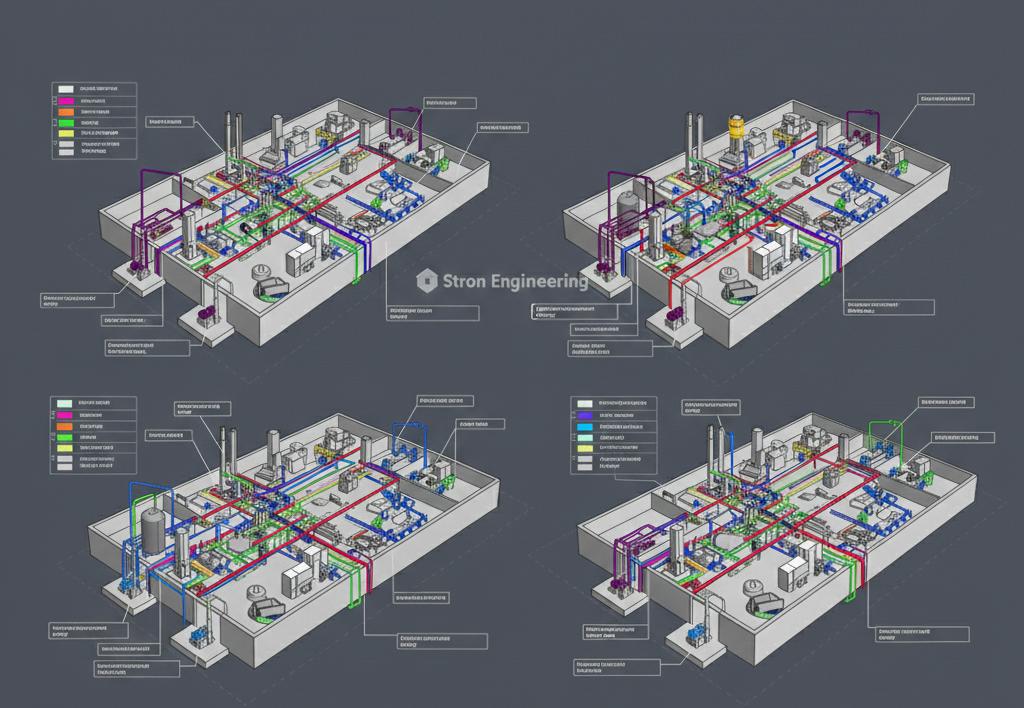
The modern approach practiced by Stron Engineering prioritizes process engineering (the TX section). First, an ideal technological process is constructed within a 3D model, and only then are the walls and foundations “fitted” around it.
Our core focus areas for 2026:
- Optimal Structural Capacity: For food production, it is vital to eliminate unnecessary columns that hinder logistics. We design long-span structures to minimize the number of supports while maintaining the load-bearing capacity required for overhead equipment.
- Foundations for Vibration Loads: Modern processing lines generate specific vibrations. Stron Engineering specialists calculate foundations with dynamic loads in mind, preventing the cracking of expensive industrial flooring.
- Utility Networks in the Model: Ventilation in food production involves massive ductwork and filtration systems. We develop these in BIM to ensure they do not conflict with process lines and remain fully accessible for maintenance
Stron Engineering Implements "Smart Audit" for Agro-Industrial Hubs
A major highlight is the launch of the “Audit 360” program by Stron Engineering. Now, prior to the reconstruction of any legacy industrial facility, the company performs full laser scanning and an audit of existing structures.
“We observe that 40% of current market projects have excessive metal consumption. Our goal is to eliminate this unnecessary weight while maintaining safety, allowing the client to redirect those saved funds toward process automation,” comments the company’s technical department.
Why 80% In-House Staff Is a Product Safety Issue?
In food plant design, you can’t just “outsource the task to a freelancer.” Collective teamwork is essential here:
- The Structural Engineer and Process Engineer must sit side-by-side to discuss whether the floor slab can support the installation of new tanks.
- The HVAC and Plumbing Engineers coordinate floor drain slopes and air purity in real-time. If engineers work in isolation, you end up with a “patchwork quilt” that falls apart during equipment installation.
Documentation Audit: Where Are You Losing Money?
Before making a construction decision, order a documentation audit from experts. In 2026, this is the only way to verify:
- Flow Compliance: Ensuring that clean raw materials do not cross paths with waste (critical for Sanitary and Epidemiological Service standards).
- Layout Efficiency: Checking if utility paths are excessively long (every extra meter of stainless steel piping is your money).
- Fire Hazards: Verifying that room categories are calculated considering the specifics of explosive dust (such as flour or sugar).
Engineering as Insurance for Your Business
By choosing Stron Engineering, you receive more than just a project—you get a guaranteed facility commissioning. Optimized material consumption, professionally laid-out technology, and an in-house expert team are the three pillars upon which your production’s ROI is built.
Stron
Engineering
-
INDUSTRIAL ENGINEERING
-
01
Development of design and estimate documentation for the construction of civil and industrial facilities, in frame and frameless design, monolithic and prefabricated structures and buildings, metal structures, reinforced concrete;
-
02
Design of outdoor power supply systems, outdoor and indoor electric lighting, power electrical equipment and substations;
-
03
Design of trunk and intra-block fiber-optic communication lines, video surveillance systems, security and access systems;
-
04
Design of external water supply, sewerage, water drainage and drainage, gas supply, and heat supply networks;
-
05
Engineering surveys (engineering-topographic; engineering-geodetic; engineering-hydrological, engineering-geological;
-
06
Technical inspection of buildings and structures;
-
07
ВIM design;
-
08
3D laser scanning;
-
09
Qualified legal support for projects.
-
01
-
MINING & METALLURGICAL ACTIVITIES
-
01
Development of design and estimate documentation for the construction of mining facilities;
-
02
Adaptation of projects and technological processes in the mining and metallurgical sector of foreign projects and design solutions to Kazakhstani norms and requirements;
-
03
Design of roads and railways;
-
04
Development of environmental projects;
-
05
Industrial safety;
-
06
Preparation of tender documentation;
-
07
Evaluation and analysis of objects to determine the cost of engineering and design;
-
08
ВIM design;
-
09
Comprehensive implementation of author's supervision;
-
10
Development of projects for related infrastructure facilities for mining, processing and metallurgical industries;
-
11
Carrying out engineering survey work.
-
01
-
MINING & METALLURGICAL ACTIVITIES
-
01
Development of design and estimate documentation for the construction of civil and industrial facilities, in frame and frameless design, monolithic and prefabricated structures and buildings, metal structures, reinforced concrete;
-
02
Design of outdoor power supply systems, outdoor and indoor electric lighting, power electrical equipment and substations;
-
03
Design of trunk and intra-block fiber-optic communication lines, video surveillance systems, security and access systems;
-
04
Design of external water supply, sewerage, water drainage and drainage, gas supply, and heat supply networks;
-
05
Engineering surveys (engineering-topographic; engineering-geodetic; engineering-hydrological, engineering-geological;
-
06
Technical inspection of buildings and structures;
-
07
ВIM design;
-
08
3D laser scanning;
-
09
Qualified legal support for projects.
-
01
-
CIVIL AND INDUSTRIAL ENGINEERING
-
01
Development of design and estimate documentation for the construction of mining facilities;
-
02
Adaptation of projects and technological processes in the mining and metallurgical sector of foreign projects and design solutions to Kazakhstani norms and requirements;
-
03
Design of roads and railways;
-
04
Development of environmental projects;
-
05
Industrial safety;
-
06
Preparation of tender documentation;
-
07
Evaluation and analysis of objects to determine the cost of engineering and design;
-
08
ВIM design;
-
09
Comprehensive implementation of author's supervision;
-
10
Development of projects for related infrastructure facilities for mining, processing and metallurgical industries;
-
11
Carrying out engineering survey work.
-
01
-
CIVIL AND INDUSTRIAL ENGINEERING
-
01
Development of design and estimate documentation for the construction of civil and industrial facilities, in frame and frameless design, monolithic and prefabricated structures and buildings, metal structures, reinforced concrete;
-
02
Design of outdoor power supply systems, outdoor and indoor electric lighting, power electrical equipment and substations;
-
03
Design of trunk and intra-block fiber-optic communication lines, video surveillance systems, security and access systems;
-
04
Design of external water supply, sewerage, water drainage and drainage, gas supply, and heat supply networks;
-
05
Engineering surveys (engineering-topographic; engineering-geodetic; engineering-hydrological, engineering-geological;
-
06
Technical inspection of buildings and structures;
-
07
ВIM design;
-
08
3D laser scanning;
-
09
Qualified legal support for projects.
-
01
-
MINING & METALLURGICAL ACTIVITIES
-
01
Development of design and estimate documentation for the construction of mining facilities;
-
02
Adaptation of projects and technological processes in the mining and metallurgical sector of foreign projects and design solutions to Kazakhstani norms and requirements;
-
03
Design of roads and railways;
-
04
Development of environmental projects;
-
05
Industrial safety;
-
06
Preparation of tender documentation;
-
07
Evaluation and analysis of objects to determine the cost of engineering and design;
-
08
ВIM design;
-
09
Comprehensive implementation of author's supervision;
-
10
Development of projects for related infrastructure facilities for mining, processing and metallurgical industries;
-
11
Carrying out engineering survey work.
-
01
-
What We Offer:
Employment:
Work in a Kazakhstan-based company
Salary:
USD 3–5 per hour.
Payment is task-based: each task is assigned with a clearly defined number of hours based on an 8-hour workday. If a task is completed ahead of schedule, payment will be made upon actual completion.
Location:
Kostanay, Kazakhstan
Key Responsibilities:
Architectural design solutions;
Coordination with engineering disciplines.
Requirements:
Higher education in Architecture;
At least 10 years of experience on industrial projects;
Technical English proficiency (mandatory);
Proficiency in Archicad, AutoCAD, Revit;
Mandatory experience working with BIM;
Relevant professional certificates and completion of specialized courses are required.

comments (0)
Leave a comment