


-
-
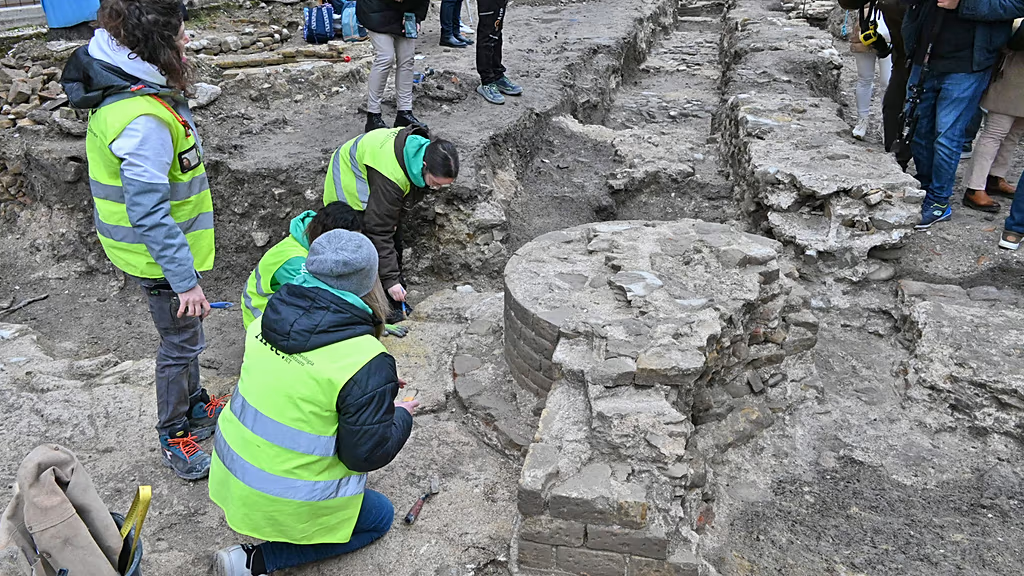
In the Italian city of Fano (Marche region), archaeologists have made one of the most significant discoveries of recent decades — the remains of an ancient Roman basilica, which researchers believe was designed by the legendary architect Marcus Vitruvius Pollio.
This find has already been compared to the “Tutankhamun tomb” due to its immense historical and cultural value.
A unique structure of ancient Roman architecture
The excavations were carried out as part of the reconstruction of Piazza Andrea Costa, when specialists discovered columns and structural elements that fully match the descriptions in Vitruvius’ treatise De Architectura.
This work is considered the only fully preserved ancient treatise on architecture and the foundation of classical architectural theory, which influenced the development of European architecture for centuries.
Vitruvius, who lived in the 1st century BC, described this building as an important public space intended for legal proceedings and civic assemblies. Over time, its exact location was lost, and it was long believed to have disappeared forever.
An archaeological discovery of global significance
According to representatives of Italy’s Ministry of Culture, the discovered basilica is the only structure that can be reliably linked to the name of Vitruvius.
The Italian Minister of Culture noted that the find is of global historical significance and will become an important milestone in the study of ancient architecture.
Local authorities emphasize that the discovery will significantly increase the tourist appeal of the Marche region and attract international attention to the city of Fano.
The influence of Vitruvius on architecture and culture
Vitruvius’ ideas became the foundation of classical Renaissance architecture. His principles of proportion inspired masters such as Leonardo da Vinci, who created the famous “Vitruvian Man.”
Today, his theories are still applied in architecture, engineering, and design, remaining relevant even more than two thousand years later.
The significance of the discovery for science and architecture
Experts believe that the discovery will provide deeper insight into the structure of ancient Roman cities and the design principles of public buildings of that era.
This finding also highlights the importance of archaeological research and the preservation of historical heritage, which shapes the cultural identity of modern cities.
Modern engineering and the legacy of Vitruvius
Such discoveries demonstrate how essential precision in calculations, a systematic approach, and engineering thinking are — principles that were already established in ancient architecture.
Today, these ideas continue to evolve in modern engineering companies such as Stron Engineering, which apply an integrated approach to the design of complex facilities, combining architecture, technology, and precise engineering solutions.
The connection between Vitruvian principles and modern technologies shows that the foundation of quality architecture remains unchanged — harmony, calculation, and engineering accuracy.
Stron
Engineering
-
INDUSTRIAL ENGINEERING
-
01
Development of design and estimate documentation for the construction of civil and industrial facilities, in frame and frameless design, monolithic and prefabricated structures and buildings, metal structures, reinforced concrete;
-
02
Design of outdoor power supply systems, outdoor and indoor electric lighting, power electrical equipment and substations;
-
03
Design of trunk and intra-block fiber-optic communication lines, video surveillance systems, security and access systems;
-
04
Design of external water supply, sewerage, water drainage and drainage, gas supply, and heat supply networks;
-
05
Engineering surveys (engineering-topographic; engineering-geodetic; engineering-hydrological, engineering-geological;
-
06
Technical inspection of buildings and structures;
-
07
ВIM design;
-
08
3D laser scanning;
-
09
Qualified legal support for projects.
-
01
-
MINING & METALLURGICAL ACTIVITIES
-
01
Development of design and estimate documentation for the construction of mining facilities;
-
02
Adaptation of projects and technological processes in the mining and metallurgical sector of foreign projects and design solutions to Kazakhstani norms and requirements;
-
03
Design of roads and railways;
-
04
Development of environmental projects;
-
05
Industrial safety;
-
06
Preparation of tender documentation;
-
07
Evaluation and analysis of objects to determine the cost of engineering and design;
-
08
ВIM design;
-
09
Comprehensive implementation of author's supervision;
-
10
Development of projects for related infrastructure facilities for mining, processing and metallurgical industries;
-
11
Carrying out engineering survey work.
-
01
-
MINING & METALLURGICAL ACTIVITIES
-
01
Development of design and estimate documentation for the construction of civil and industrial facilities, in frame and frameless design, monolithic and prefabricated structures and buildings, metal structures, reinforced concrete;
-
02
Design of outdoor power supply systems, outdoor and indoor electric lighting, power electrical equipment and substations;
-
03
Design of trunk and intra-block fiber-optic communication lines, video surveillance systems, security and access systems;
-
04
Design of external water supply, sewerage, water drainage and drainage, gas supply, and heat supply networks;
-
05
Engineering surveys (engineering-topographic; engineering-geodetic; engineering-hydrological, engineering-geological;
-
06
Technical inspection of buildings and structures;
-
07
ВIM design;
-
08
3D laser scanning;
-
09
Qualified legal support for projects.
-
01
-
CIVIL AND INDUSTRIAL ENGINEERING
-
01
Development of design and estimate documentation for the construction of mining facilities;
-
02
Adaptation of projects and technological processes in the mining and metallurgical sector of foreign projects and design solutions to Kazakhstani norms and requirements;
-
03
Design of roads and railways;
-
04
Development of environmental projects;
-
05
Industrial safety;
-
06
Preparation of tender documentation;
-
07
Evaluation and analysis of objects to determine the cost of engineering and design;
-
08
ВIM design;
-
09
Comprehensive implementation of author's supervision;
-
10
Development of projects for related infrastructure facilities for mining, processing and metallurgical industries;
-
11
Carrying out engineering survey work.
-
01
-
CIVIL AND INDUSTRIAL ENGINEERING
-
01
Development of design and estimate documentation for the construction of civil and industrial facilities, in frame and frameless design, monolithic and prefabricated structures and buildings, metal structures, reinforced concrete;
-
02
Design of outdoor power supply systems, outdoor and indoor electric lighting, power electrical equipment and substations;
-
03
Design of trunk and intra-block fiber-optic communication lines, video surveillance systems, security and access systems;
-
04
Design of external water supply, sewerage, water drainage and drainage, gas supply, and heat supply networks;
-
05
Engineering surveys (engineering-topographic; engineering-geodetic; engineering-hydrological, engineering-geological;
-
06
Technical inspection of buildings and structures;
-
07
ВIM design;
-
08
3D laser scanning;
-
09
Qualified legal support for projects.
-
01
-
MINING & METALLURGICAL ACTIVITIES
-
01
Development of design and estimate documentation for the construction of mining facilities;
-
02
Adaptation of projects and technological processes in the mining and metallurgical sector of foreign projects and design solutions to Kazakhstani norms and requirements;
-
03
Design of roads and railways;
-
04
Development of environmental projects;
-
05
Industrial safety;
-
06
Preparation of tender documentation;
-
07
Evaluation and analysis of objects to determine the cost of engineering and design;
-
08
ВIM design;
-
09
Comprehensive implementation of author's supervision;
-
10
Development of projects for related infrastructure facilities for mining, processing and metallurgical industries;
-
11
Carrying out engineering survey work.
-
01
-
What We Offer:
Employment:
Work in a Kazakhstan-based company
Salary:
USD 3–5 per hour.
Payment is task-based: each task is assigned with a clearly defined number of hours based on an 8-hour workday. If a task is completed ahead of schedule, payment will be made upon actual completion.
Location:
Kostanay, Kazakhstan
Key Responsibilities:
Architectural design solutions;
Coordination with engineering disciplines.
Requirements:
Higher education in Architecture;
At least 10 years of experience on industrial projects;
Technical English proficiency (mandatory);
Proficiency in Archicad, AutoCAD, Revit;
Mandatory experience working with BIM;
Relevant professional certificates and completion of specialized courses are required.
comments (0)
Leave a comment